The Boundless Mind
Aesop Turned Sensibility Into Desire
Date:
August 18, 2026
Before Aesop, no bottle was something you wanted displayed on a vanity counter before you understood why. Luxury self-care existed. Heritage brands existed, the classic names a grandparent might have kept in a bathroom cabinet for decades. But there was no object in this category that functioned as a signal, something people wanted to own and be seen owning, not to show off, but to quietly possess. Aesop built that category from nothing, and the space it created still hasn't been fully replicated by anyone who has tried.

Aesop Turned Sensibility Into Desire
Before Aesop, no bottle was something you wanted displayed on a vanity counter before you understood why. Luxury self-care existed. Heritage brands existed, the classic names a grandparent might have kept in a bathroom cabinet for decades. But there was no object in this category that functioned as a signal, something people wanted to own and be seen owning, not to show off, but to quietly possess. Aesop built that category from nothing, and the space it created still hasn't been fully replicated by anyone who has tried.
Arriving already sure of itself
By the time Aesop arrived, self-care and apothecary products were a well-understood category. Everyone knew what a soap was for. Everyone knew what a moisturiser did. The category wasn't broken, and Aesop didn't enter it trying to prove a point or rebel against an incumbent. It entered with a settled point of view about what this category could mean, communicated with total confidence and almost no volume.
That posture matters more than it might first appear. Most brands that want to stand out in a mature category do so by being louder: bigger claims, brighter packaging, more visible marketing. Aesop did close to the opposite in every dimension where it could have gone loud. Where competitors leaned on the science behind their formulas, Aesop leaned on the thinking behind the ritual. Where others might have chased every collaboration available, Aesop stayed restrained, a concise offering that never strayed from the experience it had already committed to. Where expansion into adjacent categories was an obvious growth lever, Aesop curated instead of sprawled.
Fluent in their own story
The founder, a Melbourne hairdresser who started mixing essential oils for his salon clients in 1987, wasn't building a beauty brand in any conventional sense. He was building a belief system that happened to take the form of skincare: that beauty should emerge from intellect, that small choices reveal character, and that thoughtfulness applied consistently is the highest form of luxury available.
What makes this different from ordinary brand positioning is how deep the consistency runs. Most brands express their values through a marketing campaign or a mission statement bolted onto operations that don't necessarily reflect it. Aesop expressed its philosophy structurally, through decisions no customer would ever directly witness. Store design, packaging, scent, material choices, and service were all treated as expressions of the same underlying idea rather than separate departments solving separate problems. Every store looks different from every other store, shaped by its specific geography and history, and yet every single one is unmistakably Aesop. That is a far harder consistency to achieve than a shared template, because it requires the philosophy itself to be doing the unifying work, not a style guide.
The service experience carries the same weight. A sink at the centre of most stores collapses the distance between private ritual and public experience, letting customers test products the way they would at home rather than across a counter. Purchases get wrapped with quiet ceremony. None of this is performed for effect. It's what happens when a brand takes the position that every interaction, no matter how small or transactional, deserves genuine attention.
Desired before it was understood
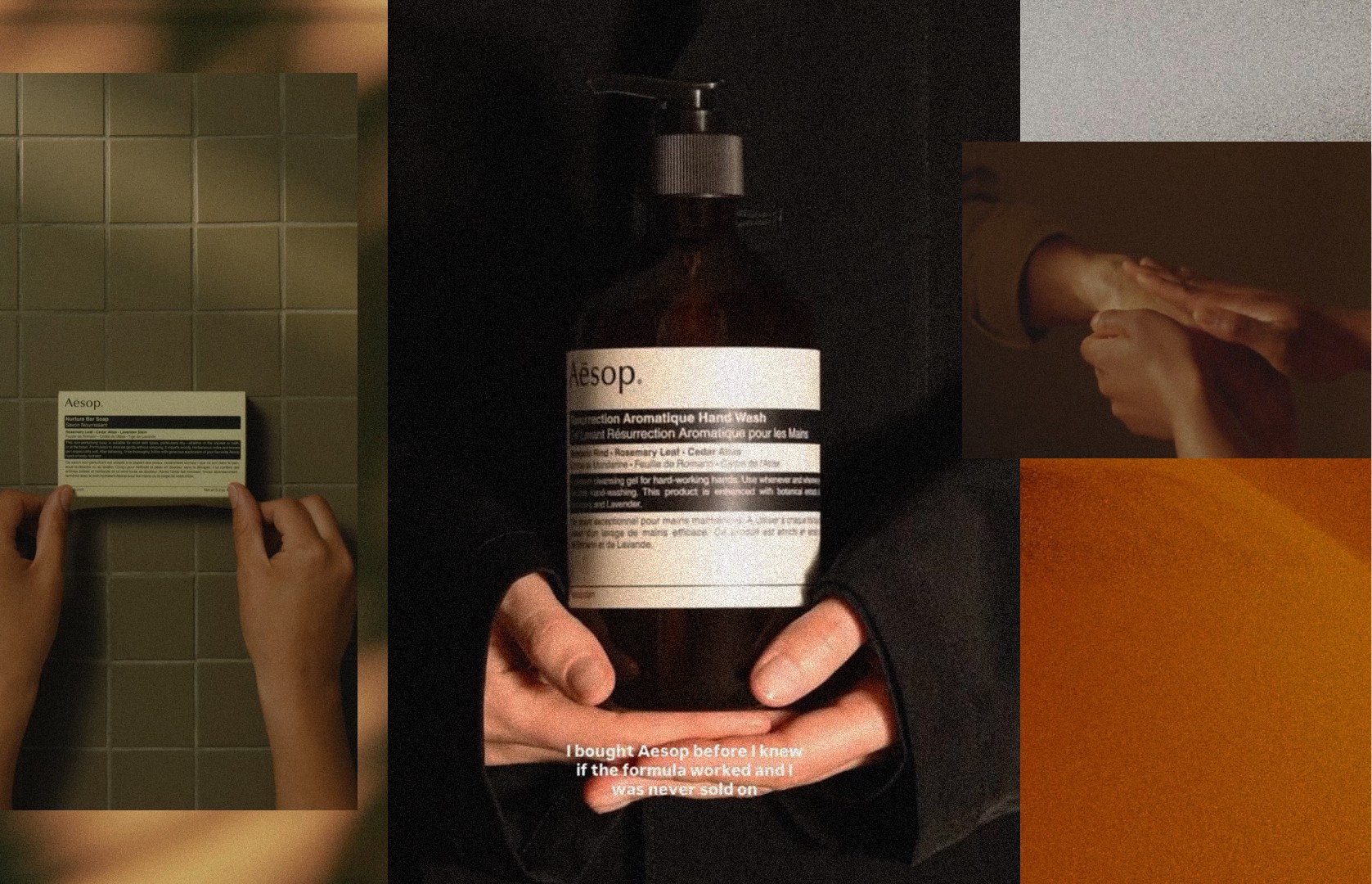
The amber hand wash bottle is the clearest evidence of what this approach actually built. It became something people wanted on their nightstand or bathroom counter before they could articulate the reason. They felt it on a sensorial level before they understood what owning it physically would mean. That is not something a marketing campaign manufactures. It's what happens when design excellence, service excellence, and sensorial experience excellence compound together long enough that the object itself becomes shorthand for all three at once.
The behaviour this produced is genuinely unusual for the category. People have been known to keep empty bottles, refill them, and decant other soaps into that unmistakable amber glass, not because the replacement product is inferior, but because of what the bottle itself signals sitting on a counter. Before Aesop, nothing in this category commanded that kind of devotion to the container rather than just the contents.
Even the mundane got recast. Something as simple as washing your hands stopped being a forgettable, functional act. Touched by Aesop's version of it, it became a deliberate pause, a small moment that signalled you cared about quality, presence, and the finer details that make ordinary days worth living properly. That is a genuinely new kind of appreciation for a category that, before this brand, nobody thought to romanticise.
The imprint Aesop left behind
The clearest proof that Aesop changed the category, rather than simply succeeding within it, is what happened to everyone who came after. An entire wave of brands, in soap, in candles, in home fragrance, now carries what has come to be recognised as the Aesop effect. Anything with a similar bottle silhouette, a similar scent profile, a similar restrained label reads as "Aesop-coded" even when the brand has no relation to it whatsoever. That's a category fingerprint, not a competitor comparison. Aesop became the reference point the entire space measures itself against, whether individual brands intend to or not.
It achieved this without shouting in any of the ways the marketing industry typically expects. No influencer blitz, no overexposed collaborations, no oversized campaign moments. Aesop became a thought leader in taste and curation through restraint applied consistently over decades, which is a much harder thing to build and a much harder thing to fake than volume ever is.
The inspiration that arrived with Aesop
The lesson here isn't really about self-care as a category. It's about what happens when a brand arrives in a mature space with genuine conviction rather than a marketing angle, and stays disciplined enough, across every single touchpoint, to make that conviction structurally real rather than just visually implied.
Most brands trying to stand out reach for more: more noise, more claims, more categories, more collaborations. Aesop's arrival proves the opposite can work, and can work more durably. A category can be reshaped permanently by a brand that says less, shows more, and refuses to compromise the thing it actually believes in, even when compromise would have been easier or faster. That is the imprint a well thought out arrival leaves behind. It doesn't just win inside the category it enters. It quietly redraws what the category is allowed to mean for everyone who enters after it.