The Boundless Mind
Virality has an expiration date
Date:
August 18, 2026
Every dessert fad follows the same shape. Cupcakes had their decade. Frozen yogurt had its run, then cronuts, then the towering monster milkshake era. Each one looked unstoppable at its peak and each one crashed the same way, market saturation, copycats flooding in, and a public that simply got bored of posting the same thing.

Why the cookie brand that broke TikTok is now the industry's leading case study in what happens next
Every dessert fad follows the same shape. Cupcakes had their decade. Frozen yogurt had its run, then cronuts, then the towering monster milkshake era. Each one looked unstoppable at its peak and each one crashed the same way, market saturation, copycats flooding in, and a public that simply got bored of posting the same thing. This isn't a cycle unique to any one product. It's the default lifecycle of a dessert built for visibility first and substance second. Cookies are the current chapter of that same story, and Crumbl is not just an example of it, it is the case industry analysts now point to as the clearest, most complete specimen of the entire arc happening in real time.
The engine that wasn't supposed to be the strategy
Crumbl didn't launch with a rotating menu as its founding idea. Cousins Jason McGowan and Sawyer Hemsley opened their first store in Logan, Utah in 2017 with a single product, a warm milk chocolate chip cookie. That was the entire menu. When demand outpaced what the small shop could bake, the founders faced a straightforward operational problem, not a marketing opportunity, and the weekly rotating lineup was born as a fix for that problem before it became anything else.
What happened next turned an operational patch into the most effective growth engine in recent dessert history. Crumbl borrowed a structure closer to sneaker culture than traditional food and beverage, a fixed weekly drop, announced on a schedule, gone within days, engineered to create urgency rather than convenience. Food creators had a permanent, renewing reason to film and post, since a new set of flavours meant new content every single week without the brand having to ask for it. The strategy solved Crumbl's kitchen capacity problem and solved its marketing problem in the same motion. The company grew from a single storefront to over a thousand locations within roughly four years, and at its peak, Crumbl's TikTok following outpaced Starbucks, Dunkin, and Krispy Kreme combined, without the company paying a single influencer to make that happen.
The reckoning
The same mechanics that built Crumbl this fast eventually started working against it. In 2023, the US Department of Labor fined multiple Crumbl franchisees across several states for child labour violations, and the resulting press coverage cost the brand far more in reputation than the fines themselves cost in dollars. Around the same period, the novelty that had powered years of frictionless growth began to fade on its own terms, independent of any single scandal. Average unit sales volume, one of the clearest health signals in franchising, dropped from 1.84 million dollars in 2022 to 1.16 million in 2023, recovered slightly to 1.35 million in 2024, then fell again to a median of roughly 1.09 million in 2025. After six consecutive years without closing a single location, Crumbl began shutting stores, nearly three dozen since 2023, alongside layoffs affecting roughly ten percent of its corporate workforce. The company quietly stopped disclosing net profitability figures in its most recent franchise documents, removing a metric prospective franchisees had relied on to evaluate the system's health. It also settled a twenty four million dollar copyright dispute with Warner Music Group over unauthorised use of popular songs in its viral social content, a detail that quietly reveals how much of the brand's early momentum depended on moving faster than the rules technically allowed.
None of this happened because Crumbl's product got worse. It happened because the specific engine that built the brand, engineered scarcity paired with constant, renewable novelty, has a hard ceiling. Novelty cannot renew indefinitely. Eventually the audience has seen enough weekly drops that the format itself stops feeling like an event.
The deliberate recalibration
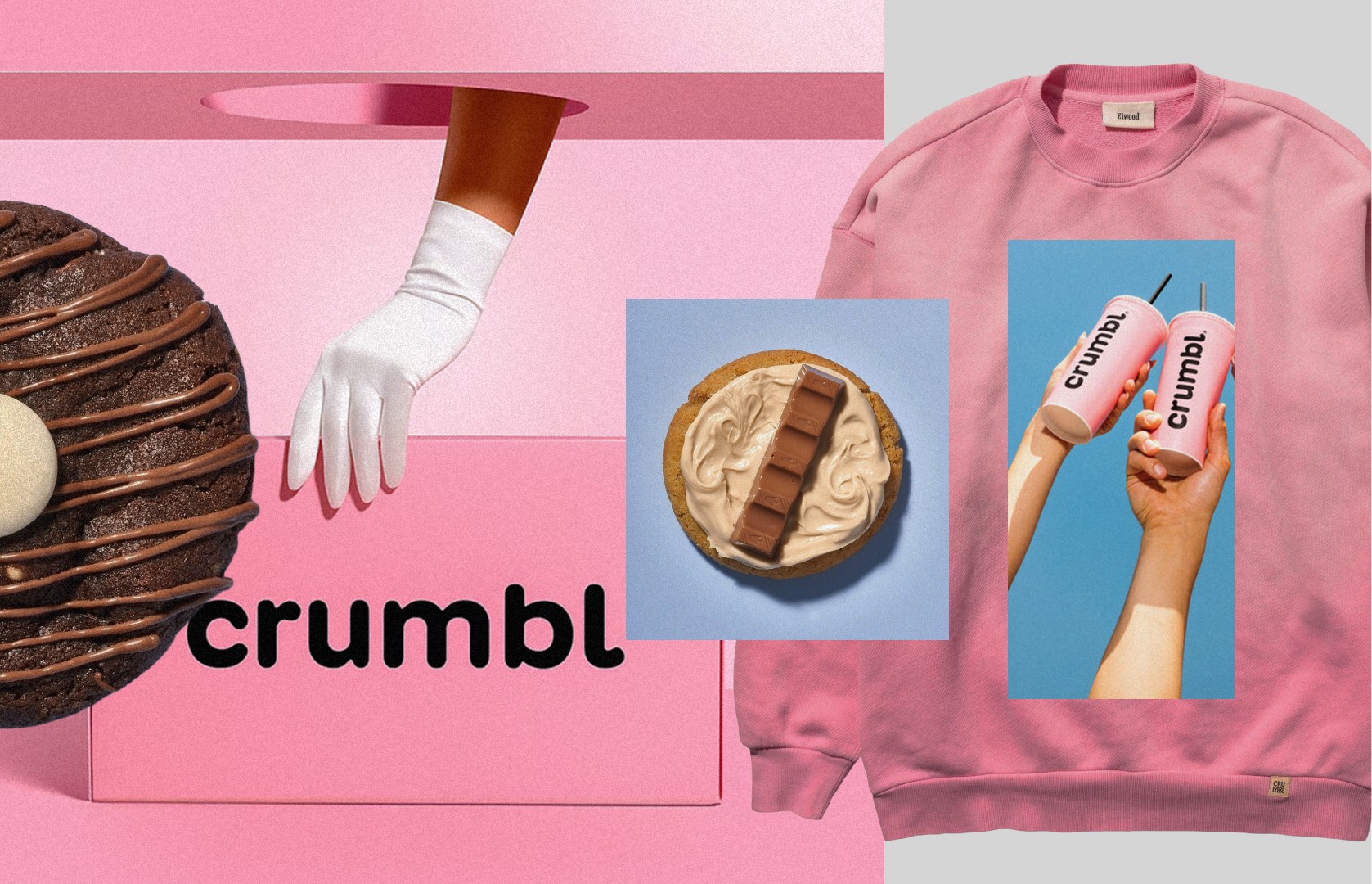
What separates Crumbl from a brand simply riding a fad to its natural end is what it did next, and did on purpose. The company rebranded, dropping its original illustrated baker mascot logo for a plain text wordmark and shortening its name from Crumbl Cookies to simply Crumbl. Then, in a more structurally significant move, Crumbl restructured its signature menu format itself, moving from a fully rotating lineup to six permanent staple flavours alongside four rotating slots. That's not a cosmetic tweak. It's a direct admission that the pure novelty model, however effective it once was, could not carry the brand on its own indefinitely, and that some of the scarcity that built Crumbl's identity had to be deliberately traded away in exchange for something steadier underneath it.
What this actually proves about the category
This is the shift worth naming plainly, and it isn't really about cookies. Any brand built primarily on engineered scarcity and constant renewal is borrowing against a finite resource, the audience's capacity to keep finding the next drop genuinely novel. That resource always runs low eventually, and when it does, the brand faces a binary choice, let the format collapse under its own repetition, or deliberately build something more permanent underneath the spectacle before the spectacle stops working on its own. Crumbl chose the second path, visibly and on the record, static staples anchoring a menu that once ran on rotation alone.
For any brand currently riding a comparable wave of manufactured virality, whether in food, beverage, or an adjacent category entirely, the lesson isn't that hype doesn't work. Hype clearly works, Crumbl's rise proves that decisively. The lesson is that the engine which gets a brand noticed is rarely the same engine capable of keeping it standing once the initial wave breaks. The brands that survive their own hype cycle aren't the ones that avoid the crash entirely. They're the ones that see it coming early enough to trade some of their spectacle for structure before the market forces that trade on far worse terms.